
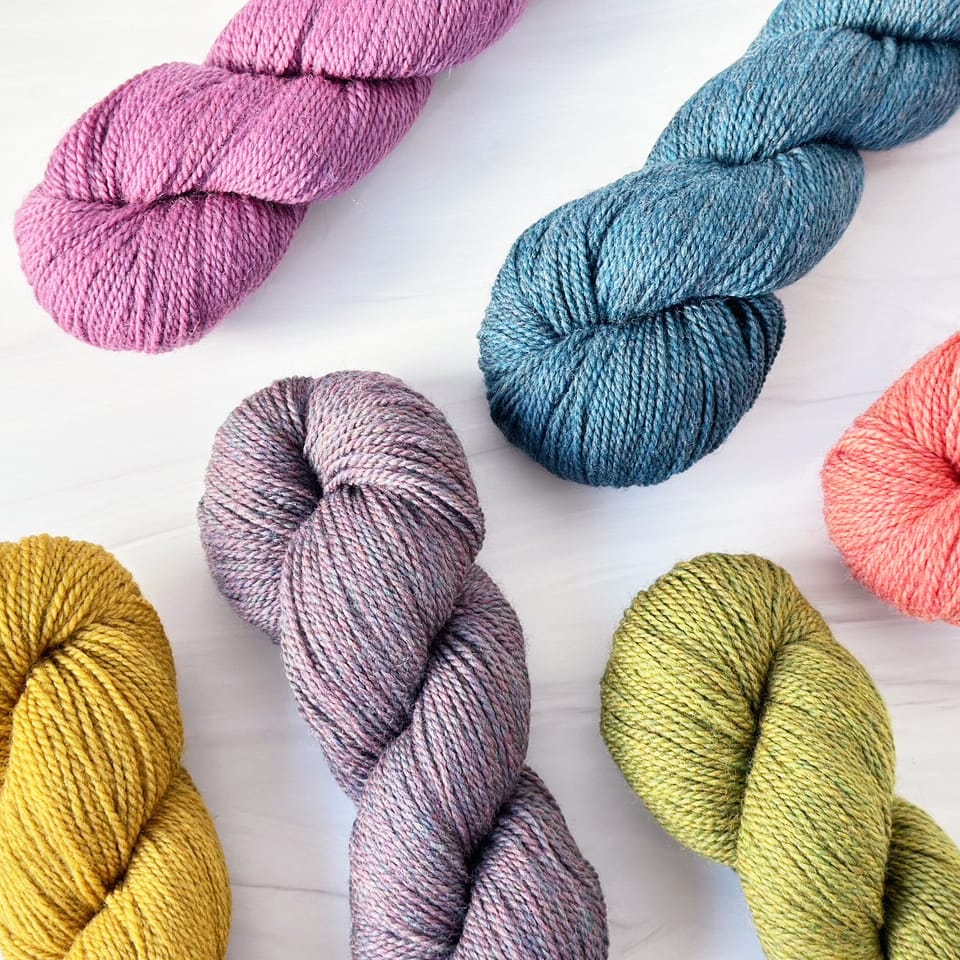

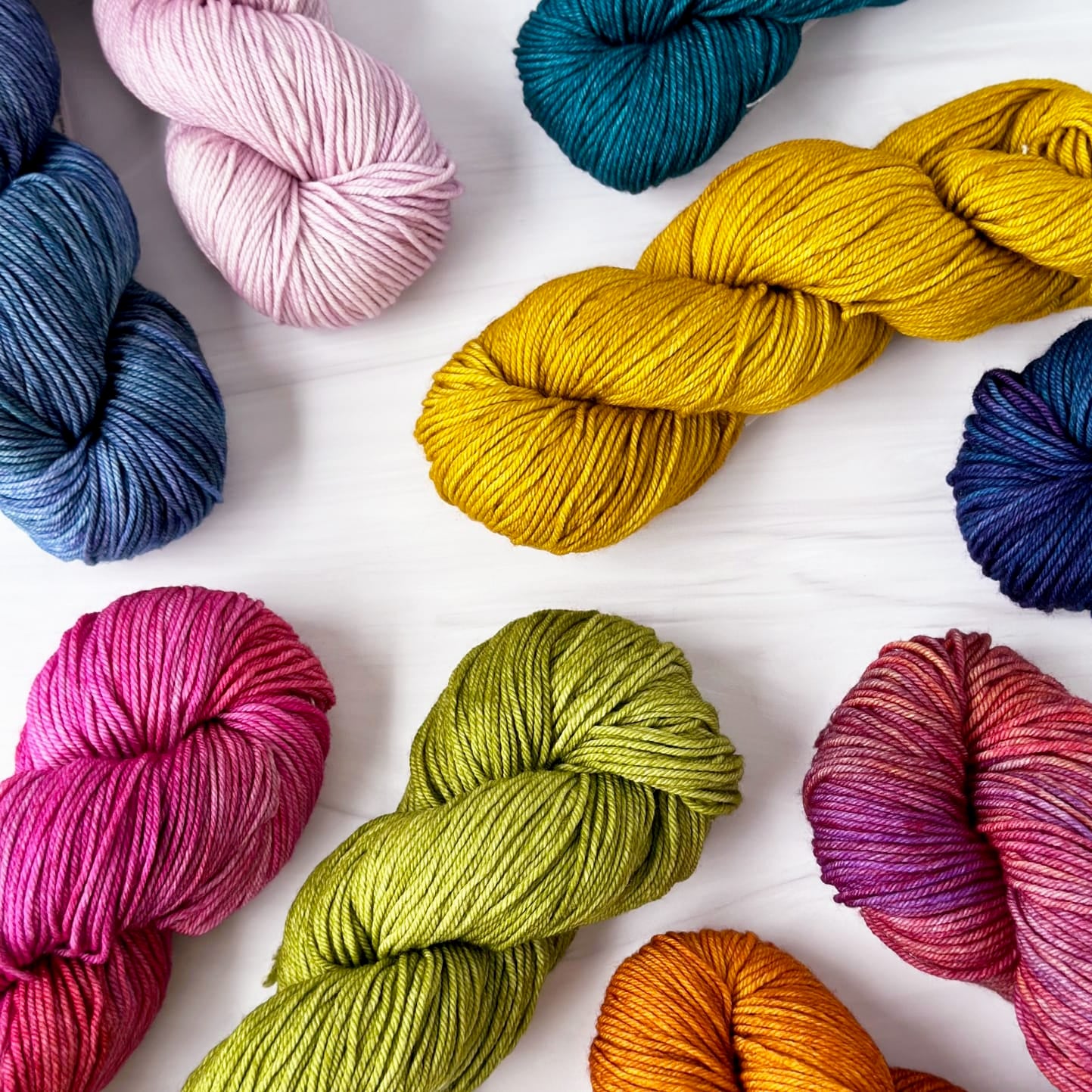









One of the most common questions we hear at Loop is, “What’s the difference between fingering, DK, and worsted yarn?”
If you’re new to knitting, yarn weights can seem confusing at first. Despite the name, yarn weight has nothing to do with how much a ball or skein weighs. Instead, it refers to the thickness of the yarn strand—and that one characteristic affects almost everything about your finished project, from how it drapes and how warm it feels to how quickly it grows and whether it fits.
The common yarn weights, from thinnest to thickest, are lace, fingering, sport, DK, worsted, chunky, and bulky. Once you understand the basic categories and how they relate to gauge, choosing yarn becomes much easier.

Shown above: lace weight Posy; fingering weight Sprig, sport weight Ewe So Sporty, DK weight Tendril, worsted weight Flora, chunky weight Lanas Quick, bulky Super Super Chunky.
What Does Yarn Weight Mean?
Yarn weight describes the thickness of a strand of yarn, not the number of grams or ounces in the skein.
Thinner yarns generally create lightweight fabrics with smaller stitches, while thicker yarns create more substantial fabrics with larger stitches. Thicker yarns also tend to knit up more quickly because each stitch covers more area.
Patterns specify a yarn weight because the thickness of the yarn affects the finished project’s size, appearance, structure, and drape. Even a yarn that is only slightly thicker or thinner than the one recommended can change the result.
Why Yarn Weight Matters
Understanding yarn weight helps you choose a yarn that will create the kind of fabric your project needs.
Yarn weight affects:
- Gauge: The number of stitches and rows in a measured area. Matching a pattern’s gauge is especially important when size matters.
- Drape: Finer yarns often create lighter, more fluid fabrics, while heavier yarns can produce more structure.
- Warmth: Thicker fabrics generally trap more air and provide more insulation.
- Knitting speed: Projects made with chunky and bulky yarns usually grow faster because the stitches are larger.
- Stitch visibility: Larger stitches can be easier to see, while finer yarns allow room for more detailed stitch patterns.
Fiber content and yarn construction also influence these qualities, so two yarns of the same weight may still create noticeably different fabrics.
Understanding Gauge
Gauge is the number of stitches and rows you knit within a certain measurement, usually four inches or 10 centimeters.
Patterns are written for a particular gauge. If your stitches are larger than the pattern calls for, your finished project will also be larger. If your stitches are smaller, your project will be smaller.
Yarn weight and gauge are closely related, but they are not exactly the same thing. Yarns within the same weight category usually work within a similar range of gauges, but the exact result depends on the yarn, needle size, stitch pattern, and individual knitter.
Whenever you’re making a sweater or another project where the finished size matters, take the time to knit, wash, and measure a gauge swatch before beginning.
Yarn Weight Chart
| Yarn Weight | Typical Stitches per Inch | Common US Needle Size | Common Metric Needle Size |
|---|---|---|---|
| Lace | 8.25–10 | US 0–1 | 2–2.25 mm |
| Fingering | 6.75–8 | US 1–3 | 2.25–3.25 mm |
| Sport | 5.75–6.5 | US 3–5 | 3.25–3.75 mm |
| DK | 5.25–6 | US 5–7 | 3.75–4.5 mm |
| Worsted | 4–5 | US 7–9 | 4.5–5.5 mm |
| Chunky | 3–3.75 | US 9–11 | 5.5–8 mm |
| Bulky | 1.75–2.75 | US 11–17 | 8–12.75 mm |
These numbers are useful guidelines rather than strict rules. The gauge listed in your pattern—and the fabric you create with your swatch—should guide your final choice.
Yarn Weight Categories
Lace Weight
Lace weight yarn is the finest of the yarn weights in this guide. When worked at a close gauge, it may produce approximately 8.25 to 10 stitches per inch on US 0 to US 1 needles.
However, lace yarn is often used for shawls, wraps, and other open stitch patterns on much larger needles. The extra space allows the lace design to open up and become visible after blocking.
Lace weight yarn, particularly silk-and-mohair blends, can also be held together with another yarn to add softness, warmth, color depth, or a delicate halo.
Common uses include:
- Shawls and wraps
- Lightweight scarves
- Delicate garments and accessories
- Holding with another yarn
Fingering Weight
Fingering weight yarn is sometimes called sock yarn or baby yarn, although it can be used for far more than socks and baby projects. It is typically knit at approximately 6.75 to 8 stitches per inch on US 1 to US 3 needles.
For socks, knitters often use smaller needles to create a dense, durable fabric. For shawls, sweaters, and tops where more drape is desirable, fingering yarn may be worked on larger needles.
Fingering weight creates lightweight garments that are comfortable to wear throughout much of the year. It also provides plenty of room for detailed colorwork, lace, and textured stitches.
Common uses include:
- Socks
- Shawls
- Lightweight sweaters and tops
- Baby garments
- Hats and accessories
Sport Weight
Sport weight yarn sits between fingering and DK. It is a little thicker than most sock yarns but still creates a relatively lightweight fabric.
Sport weight is typically knit at approximately 5.75 to 6.5 stitches per inch on US 3 to US 5 needles. It is a good choice when you want a little more warmth and substance than fingering weight without committing to a heavier yarn.
Common uses include:
- Lightweight sweaters and cardigans
- Baby and children’s garments
- Hats, cowls, and other accessories
DK Weight
DK weight yarn is generally knit at approximately 5.25 to 6 stitches per inch on US 5 to US 7 needles.
DK is a particularly useful weight for sweaters. It creates fabric that feels substantial without becoming especially heavy and allows projects to grow more quickly than they would in fingering or sport weight yarn.
Many knitters find that DK offers an appealing balance of warmth, drape, structure, and knitting speed.
Common uses include:
- Sweaters and cardigans
- Children’s garments
- Hats
- Cowls and scarves
- Mittens and other accessories
Worsted Weight
Worsted weight yarn is generally worked at approximately 4 to 5 stitches per inch on US 7 to US 9 needles.
It is one of the most versatile and widely used yarn weights. The needles are comfortable for many knitters to handle, projects grow at a satisfying pace, and the resulting fabric works well for everything from sweaters to blankets.
Worsted weight is approachable for newer knitters, but it is not the yarn we usually choose for Loop’s beginner classes. We prefer chunky yarn because its larger individual stitches are easier to see and the work grows more quickly.
Common uses include:
- Sweaters
- Hats and mittens
- Scarves and cowls
- Blankets
- Home accessories
Chunky Weight
Chunky weight yarn is generally knit at approximately 3 to 3.75 stitches per inch on US 9 to US 11 needles. It creates a warm, substantial fabric, and the larger stitches allow projects to grow quickly.
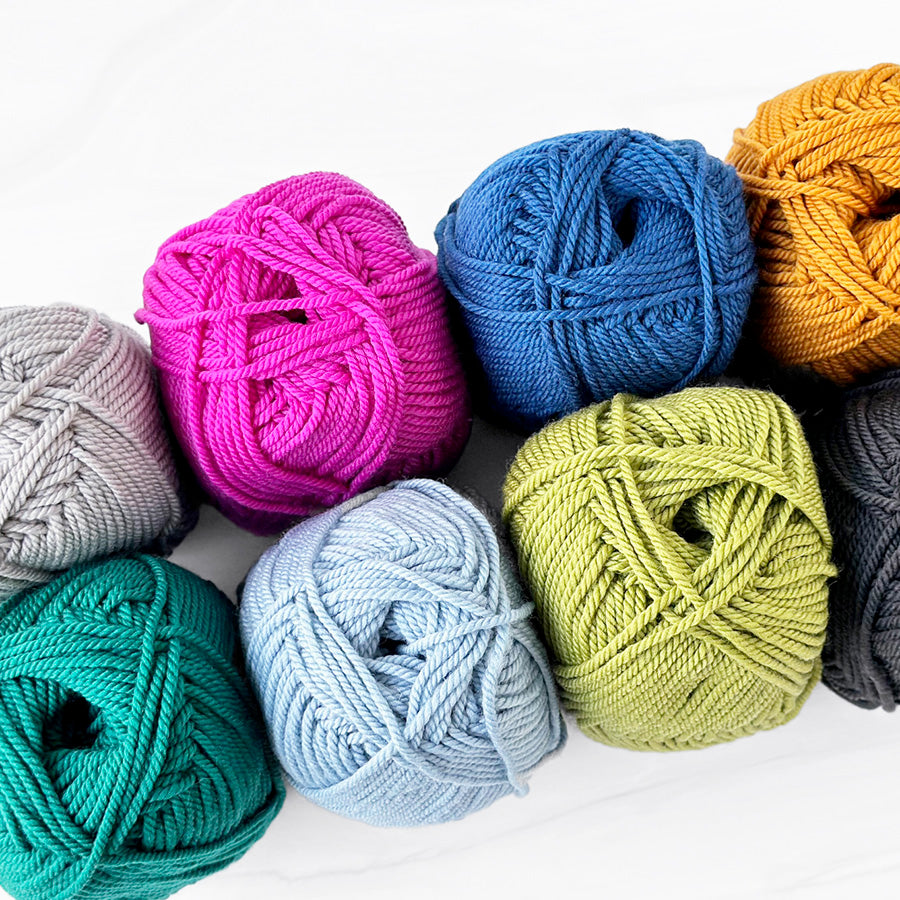
Chunky is the weight we recommend for beginning knitters and use in our beginner knitting classes. Because the individual stitches are larger, students can more easily see how knitting is constructed, distinguish knit stitches from purl stitches, and recognize mistakes.
The work also grows quickly, so new knitters can clearly see their progress. That early sense of accomplishment makes learning more satisfying and helps students stay motivated.
Common uses include:
- Beginner knitting projects
- Hats
- Cowls and scarves
- Warm sweaters
- Quick gifts
Bulky Weight
Bulky weight yarn is generally knit at approximately 1.75 to 2.75 stitches per inch on US 11 to US 17 needles.
Bulky yarn creates bold, oversized stitches and allows hats, scarves, blankets, and even sweaters to come together quickly. It can be a satisfying choice for instant-gratification projects and last-minute gifts.
Although bulky yarn is thicker than chunky, thicker does not always mean easier for a beginner. Very large needles and oversized stitches may feel awkward to manage, which is why we generally find chunky yarn offers a better balance of visibility, speed, and control for someone who is learning.
Common uses include:
- Blankets
- Statement scarves and cowls
- Winter hats and accessories
- Oversized sweaters
- Quick gifts
Yarn Weight Categories Are Ranges
Yarn weight categories are starting points, not exact measurements. One fingering weight yarn may be noticeably thicker than another, and some worsted yarns knit more like DK while others sit closer to chunky.
Fiber content, the way a yarn is spun, the number of plies, and the amount of air within the strand all affect how thick a yarn appears and how it behaves when knitted.
This is why experienced knitters look at the yarn’s suggested gauge as well as its weight category. When following a pattern, matching the designer’s gauge is more important than finding a yarn with exactly the same descriptive label.
Can You Substitute One Yarn Weight for Another?
When following a pattern, it is usually best to choose a yarn in the weight the designer recommends. This gives you the best chance of matching the intended gauge and creating a fabric with the right drape, density, and structure.
Substituting another yarn within the same weight category is often straightforward, but you should still compare:
- The pattern’s required gauge
- The yarn’s recommended gauge
- Fiber content
- Yarn construction
- Yardage per skein
- The qualities of the intended fabric
Using an entirely different yarn weight may be possible, but simply changing the needle size is not always enough. A heavier or lighter yarn can alter the project’s measurements, proportions, drape, warmth, and overall appearance.
How to Choose the Right Yarn Weight
If you’re following a pattern, begin with its recommended yarn weight and gauge. That is the simplest way to create the size and fabric the designer intended.
If you’re choosing yarn without a pattern, consider the following:
- What are you making? A lightweight summer top requires a different fabric from a warm winter hat.
- How warm should it be? Finer yarns generally create lighter fabrics, while thicker yarns produce more insulation.
- How quickly would you like the project to grow? Chunky and bulky yarns usually knit up faster.
- How should the fabric behave? Think about drape, structure, density, and how the finished item will be worn or used.
- How clearly do you need to see the stitches? Chunky weight is particularly helpful for beginners because its larger stitches make the structure of the knitting easier to recognize.
There is no single best yarn weight for every project. The right choice is the one that creates the fabric your project needs and gives you a knitting experience you’ll enjoy.
Explore Yarn by Weight
We’ve organized our yarn collections by weight to make it easier to find an appropriate yarn for your next project:
- Lace Weight Yarn
- Fingering Weight Yarn
- Sport Weight Yarn
- DK Weight Yarn
- Worsted Weight Yarn
- Chunky Weight Yarn
- Bulky Weight Yarn
If you’re still unsure which yarn is right for your project, we’re always happy to help. Stop by our South Street shop in Philadelphia, email us at knit@loopyarn.com, or call 215-893-9939. No question is too basic—we love talking yarn!